ALBELA productionour own sheet, our own machines, our own quality control
ALBELA does not resell finished pieces and does not assemble them from bought-in sheet. The stone is cast on our own site in Kirishi, and the same site cuts, thermoforms, bonds and polishes that sheet into a finished basin, countertop, bathtub or mirror. Below: the floor space, the capacity, the equipment and how every piece is checked.
Site and capacity
From stone to object
Most ALBELA pieces start as sheet cast in house: it is heated, formed, bonded and worked back into a monolith. Bathtubs and selected models are cast in a mould. Both routes run on the same site.
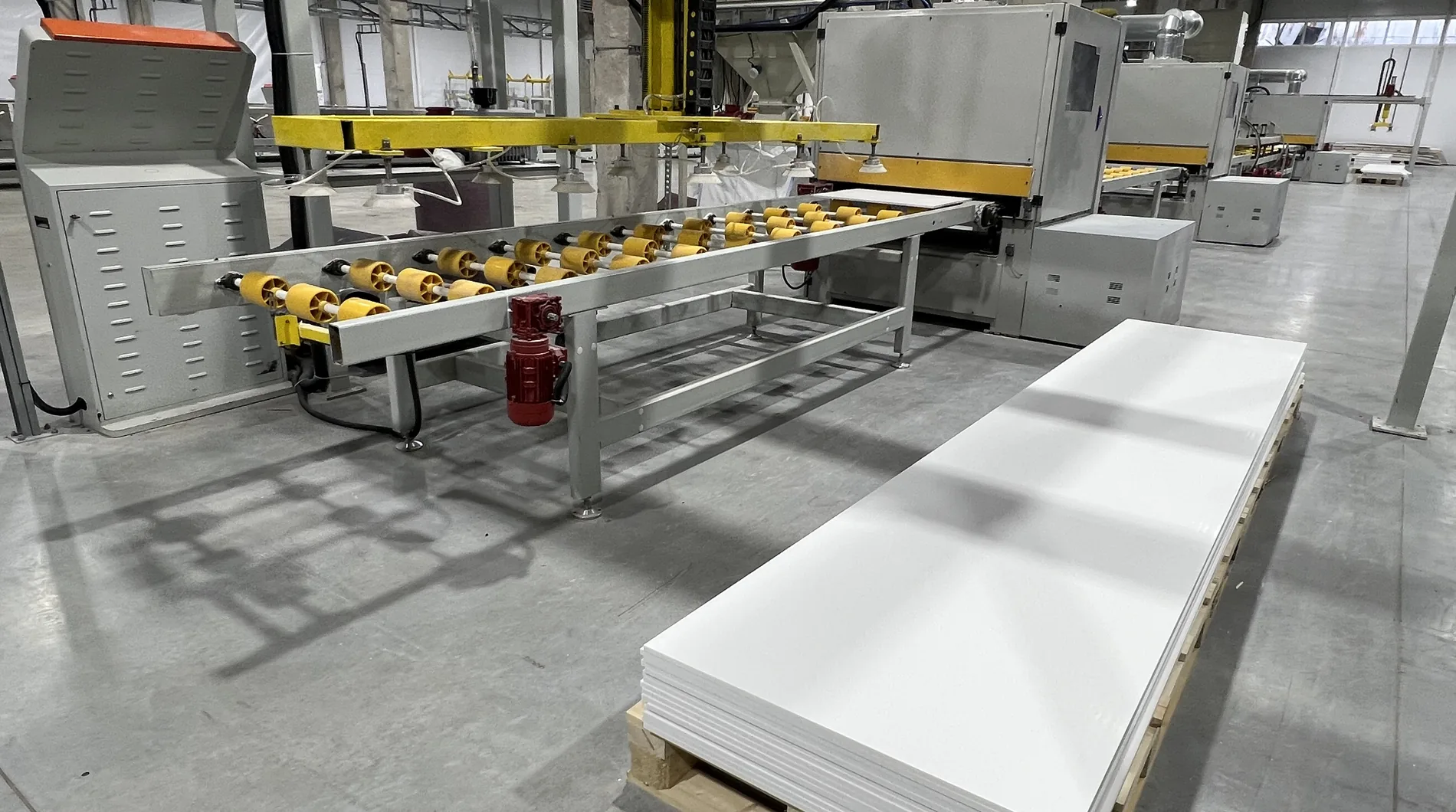
Sheet handling on the line is done by vacuum manipulators and machining by CNC equipment. There are no industrial robots on site: forming, bonding and finishing remain the work of a craftsman, and that work is what decides how the joint turns out.
Why a piece takes 20–35 days
Site capacity and the lead time of one order are different things. Every piece is made to its own dimensions, cut-outs, finish and lighting, so it joins a queue and follows its own machining route. The lead time is set by the queue and by custom dimensions, not by line capacity.
- Countertop basins, countertops, care products — in stock.
- Floor-standing basins and mirrors — 20 working days.
- Bathtubs — 35 working days.
- Trade batches from 10 units — from 15 working days, terms for furniture makers.
We cast the stone ourselves
The sheet ALBELA pieces are made from is cast on this same site. The material has its own industrial brand — LISTACRYL — under which it is supplied to furniture makers and fabricators.
That is a market test in itself: the material in your bathroom is bought by plants that depend on batch-to-batch consistency.
The binder is pure PMMA acrylic resin with no styrene; the filler is aluminium trihydrate ATH. Pigment runs through the full thickness, so wear does not change the shade and a scratch is sanded out in place.
Two checkpoints and three laboratories
- Incoming inspection. Resin and filler are checked before they enter the mix: the raw batch decides the strength and colour of the whole slab.
- Final inspection. Each finished piece is checked for geometry, joint quality and surface before packing.
- Laboratories and test benches. Three laboratories and two test benches on site: formulations, heat resistance, strength, structural uniformity.
- Reject rate under 2% by internal records. A piece that fails inspection goes back into production, not to a customer.
Who makes it, and what is left over
The team
The material is run by staff chemical technologists: formulation, sheet casting, laboratory. The pieces are made by engineers and shop-floor craftsmen; machine operators are trained on site, on the equipment they will work on. The team is stable, with no turnover on the shop floor.
Waste
Offcuts, milling swarf and pieces that fail inspection do not go to landfill: about 90% of waste returns to production. Acrylic solid surface allows this — the material is uniform through its whole mass.