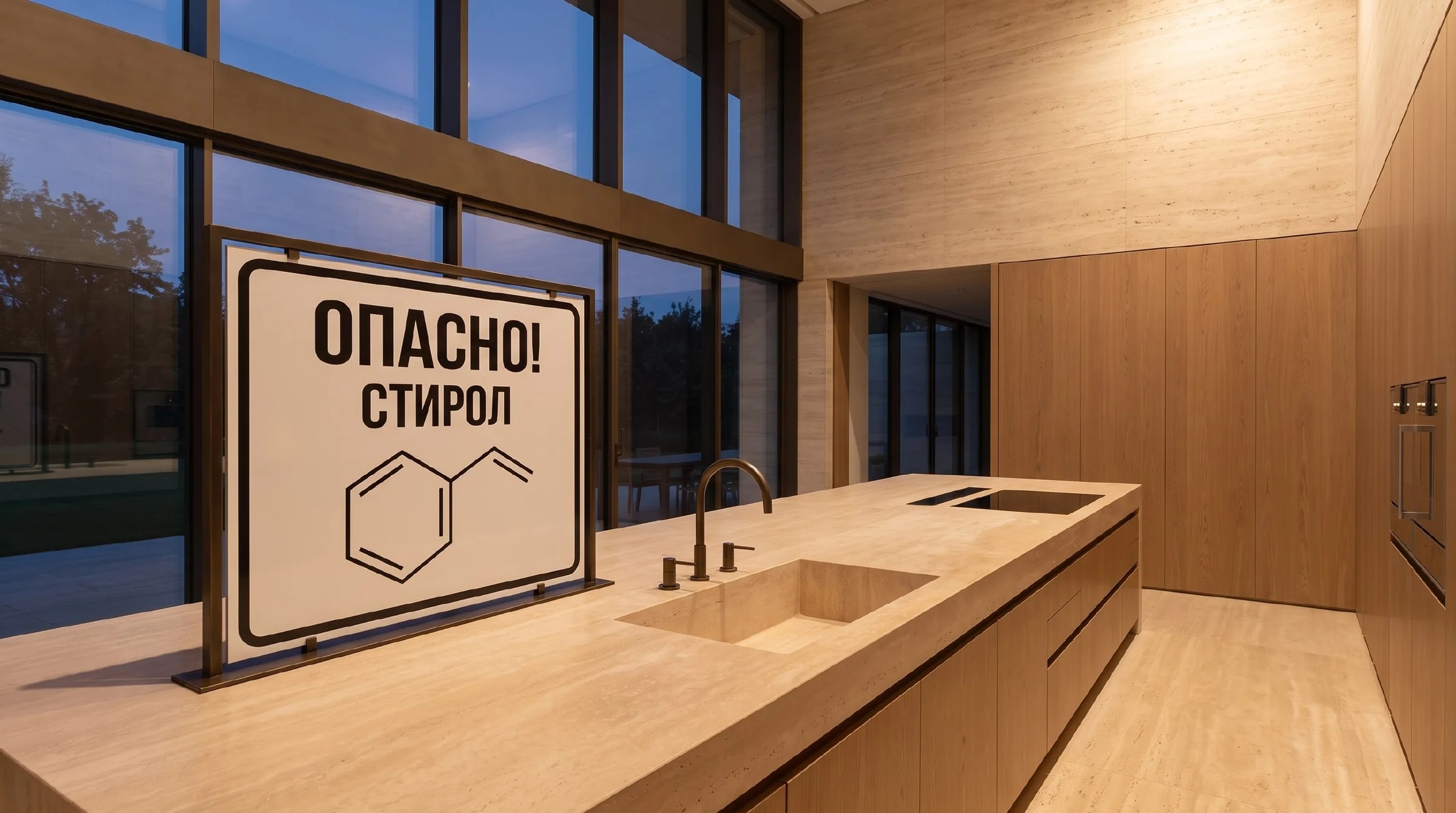
Styrene in solid surfacewhere it comes from, why it matters, and how to tell if it's in your piece
Different materials are sold under the phrase "artificial stone". A significant share of them are built on polyester resin, where styrene makes up a third of the binder's mass. If a piece has not gone through factory thermal post-curing, some of that styrene stays unbound and leaches into room air for years. Below is how this chemistry works, what regulators say about styrene, and why ALBELA products contain none of it.
Where styrene in stone comes from
Polyester resin is an unsaturated polyester dissolved in styrene. Styrene plays two roles here at once: as a solvent, giving the resin the fluidity to be poured into a mould, and as a cross-linking monomer that, on curing, becomes part of the three-dimensional network and links the polymer chains together. Styrene makes up roughly 30-40% of the mass of such a resin.
While the reaction is running, styrene is consumed. The problem starts where the reaction does not go to completion: all the monomer that never got bound into the network stays in the material in free form.
Why monomer remains in the finished piece
Free-radical polymerisation never reaches 100% conversion on its own. To "finish off" the residual monomer, a piece is sent for post-curing after it leaves the mould — held in a thermal chamber at an elevated temperature. This is a separate operation: a chamber, energy, hours of production time.
Curing with an initiator, followed by thermal post-curing at an elevated temperature for several hours. Conversion is pushed to its limit, and almost no free monomer remains in the matrix.
The casting is held at room temperature and goes straight to sanding. No thermal chamber is needed, the cycle is shorter, and the cost is lower. Some of the monomer stays unbound in the process — and it stays in the piece that arrives at the customer's home.
Free styrene is volatile. It gradually migrates from deep inside the matrix to the surface and evaporates — a process stretched over years and accelerated by heat: hot water, steam, underfloor heating, built-in lighting, kitchen appliances nearby. None of this shows from the outside: the gelcoat looks equally glossy on a piece that went through the thermal chamber and one that never saw it.
What is known about styrene
In 2019 the International Agency for Research on Cancer (IARC) classified styrene and its main metabolite, styrene-7,8-oxide, as Group 2A — probably carcinogenic to humans. With sustained inhalation, styrene irritates the respiratory mucosa and has a depressant effect on the central nervous system.
- IARC classification
- Group 2A — probably carcinogenic to humans (2019 reassessment)
- Residential air, Russia
- Average daily exposure limit — 0.002 mg/m³, one of the strictest values among organic solvents
- Contact with food media, Russia
- Styrene migration is regulated at 0.01 mg/l in model media
- Nature of exposure
- Chronic, low-dose, spread over time — which is exactly why average daily values, not one-off peaks, are regulated
What the rules say: Russia, the EU and the US
No jurisdiction bans polyester resins outright "by name". Everywhere, the principle is migration limits. The difference is in how strictly the finished piece is tested, and under which framework it even reaches the market.
- Russia and the EAEU
- Sanitary requirements regulate both styrene migration into model media and its concentration in residential air. But furniture-type products are certified under Customs Union technical regulation 025/2012, which checks the surrounding air, not direct contact with food and water
- European Union
- Styrene is permitted as a starting substance for food-contact plastics and has no dedicated migration limit of its own. After IARC's reclassification, the EU's EFSA placed styrene in the highest-priority group for introducing such a limit — meaning the question remains open at the regulator itself
- United States
- FDA standards (21 CFR) and NSF/ANSI 51 require laboratory testing for monomer extraction into aqueous, acidic and fatty media. A material only reaches a kitchen after passing these tests
Why ALBELA has no styrene
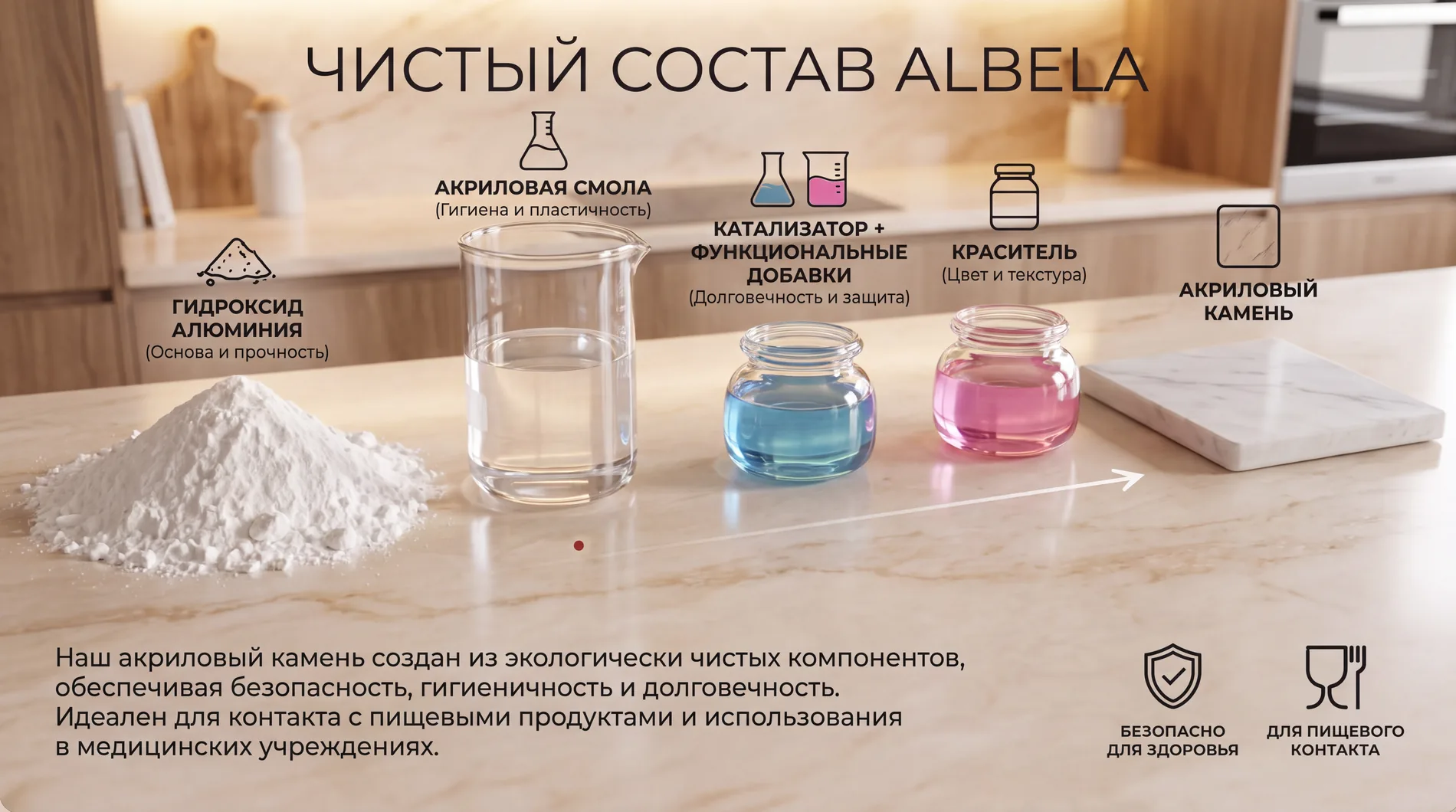
We cast our pieces from acrylic solid surface: the binder is acrylic resin based on methyl methacrylate, and the filler is aluminium trihydrate (ATH). Cross-linking happens through acrylate groups; styrene is not used as a cross-linking monomer and is not part of the formula — there is nothing for it to release.
Casting, polymerisation and post-curing all happen on our own line in Kirishi. We set the regime ourselves, rather than relying on a contractor with no thermal chamber.
Our bathtubs with a different binder
A few models in our catalogue — ORION, ORION DECO and BAROQUE — use a binder that is not acrylic resin but polyester acrylate (PEA). The name looks similar to "polyester resin", and we do not hide it in the specifications. But it is a different class of material: an oligomer with acrylate end groups that cross-links through acrylate, with no styrene bridge.
These models are a cast composite, not solid surface, so the "Acrylic resin · Solid surface" mark does not appear on them. If a pure PMMA with mineral filler matters to you, look for the pieces that carry the mark — most of the catalogue does.
Six questions to ask a seller
- Which binder is it — acrylic (PMMA) resin or polyester? This is a closed question and deserves a closed answer. "Premium composite" and "European raw material" is not an answer.
- Does the piece go through thermal post-curing? Ask for the temperature and duration. A producer that actually has a thermal chamber will name the regime without hesitation.
- What documents are available? Ask for a sanitary-chemical test report, not just a conformity certificate on letterhead.
- Is the material uniform through its full thickness? A useful sign, but not proof on its own. Cheap castings under a thin gelcoat do show a differently coloured base underneath — that answers the question right away. But there are also polyester solid surface products, uniform through their mass and with no gelcoat: Montelli from DuPont and equivalents from Chinese manufacturers are an economical substitute for acrylic stone, visually indistinguishable from it. The binder there is still polyester. A uniform cross-section is an argument for casting quality, not proof of the absence of styrene.
- Can the material be thermoformed? This is the real tell. Polyester stone does not stretch under heat — you cannot make a deep one-piece basin or a bent edge without bonding. If a seller shows a seamless three-dimensional shape and says "polyester" — something in that pairing is not true.
- What does the piece smell like in a warm room? A sweetish "plastic" smell that gets stronger after hot water is poured is a bad sign.
Common questions about styrene
So is any polyester stone dangerous?
No. A polyester piece that has gone through full thermal post-curing releases very little residual monomer. The problem is not the chemical class itself, but that a buyer has no way to check whether that step was actually performed on their particular piece. With acrylic stone this question does not arise: there is no styrene in the formula.
How long can a piece keep releasing styrene?
Emission peaks in the first weeks after manufacture and then slowly declines, but it is stretched over years as the monomer gradually migrates out from deep inside the matrix. Every heating event — hot water, steam, underfloor heating — temporarily speeds up the process.
Does acrylic stone have any smell?
A finished piece has no odour in either cold or hot water. A smell only appears during machining — that is sanding dust, not a volatile monomer, and it disappears as soon as the area is cleaned.
Is quartz agglomerate styrene-free?
Quartz agglomerate is about 90% mineral chips, with the binder making up roughly a tenth of it — and that binder is most often polyester resin too. The same question applies, just with a noticeably smaller mass of binder involved. Agglomerate also cannot be restored by sanding and cannot be thermoformed.
How does ALBELA back up its material composition?
Certificates and test reports for the material are published in the Documents section. Each model's composition is listed in its specifications — including the three bathtubs whose binder differs from the rest of the range.